

By Councilwoman Jan Dubauskas
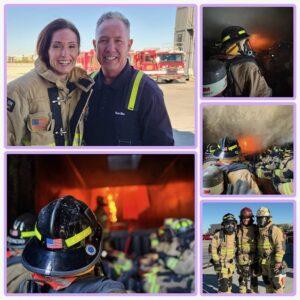
As Chairwoman of the Public Safety Committee, I have the privilege of working closely with Scottsdale’s Police and Fire Departments. Nothing compares to the thrill of saying “yes” to rare opportunities that let me witness—and even participate in—the rigorous training for our first responders.Last week, I joined Scottsdale Fire Department recruits for their first live flashover training in the department’s flashover chamber. Several city employees who had done it before warned me: it’s unforgettable, and so intense that they wouldn’t volunteer for it again. That only piqued my curiosity: what exactly is a flashover?
Understanding Flashover
Flashover is one of the deadliest phases of a fire. It’s the near-simultaneous ignition of all exposed combustible materials in an enclosed space, often triggered when superheated gases and smoke reach their ignition point. Temperatures soar to 1,000°F (or more), thick smoke obscures everything, and introducing oxygen (air) can cause flames to erupt across the ceiling in seconds. What looks like harmless smoke can suddenly become a wall of fire. It’s visually dramatic—and utterly lethal.
Preparation: Safety First
We arrived at 7 a.m. on March 6, 2026. Chief Shannon and the team exuded calm professionalism from the start. They were clear: safety is non-negotiable.
Into the Chamber
Fully kitted—helmet, mask, 60+ pounds of turnout gear and an oxygen tank—we stepped inside. The chamber is a controlled burn room with hand-held thermal imaging displays showing real-time temperatures.Chief Shannon and I started at the back, with eight firefighters ahead; they were rotating every few minutes to experience the heat from the fire. Captain Dutcher, the instructor at the front, managed the blaze masterfully, using fuel in a can to demonstrate the stages: temperatures climbing from 200°F to over 1,000°F.Captain Dutcher taught continuously for 25 minutes—identifying fire behavior, entry tactics, how to avoid triggering flashover, and survival steps if it occurs. His calm commands adjusted ventilation: “Open the chimney,” “Close the door.” When ventilation was restricted, the visible flames died down—but the heat built relentlessly in the smoke layer above.
The Moment of Flashover
Then it happened. Smoke swirled thick and dense; I couldn’t see the firefighter next to me. His thermal imager revealed what our eyes couldn’t: fire spreading overhead, hidden in the smoke. The instructor called for the door to open.Oxygen rushed in. Instantly, orange flames rolled across the ceiling like fingers reaching out—so close, they were within arm’s length. The fire hunted for more fuel, yet the chamber contained it safely. Our gear’s thermal protection was so effective we felt only warmth, not the lethal 1,000°F reality.This exercise drove home a critical lesson: firefighters can’t rely solely on what they see or feel. They must read conditions—smoke color, heat layering, ventilation—to anticipate dangers invisible to the untrained eye.
Aftermath and Decontamination
Exiting, we were immediately checked for burns or injuries (none, thankfully). Decontamination followed: a thorough water spray to remove carcinogens from gear, which is sanitized before it can be reused. It was a relief to take off the 60 lbs of gear, breathe fresh air, and reflect on the skilled professionalism displayed throughout this extreme training exercise.
Why It Matters
Public safety is the foundation of Scottsdale’s success. Our residents rely on us to provide them with a safe home. And we welcome nearly 12 million visitors annually, who generate a $3.7 billion economic impact. Residents and visitors come here because they feel—and are—safe.Firefighters run toward danger while most of us flee. They risk their lives to save others, training relentlessly in conditions like this to stay one step ahead of fire’s unpredictability.Experiencing flashover firsthand deepened my respect and gratitude for our incredible Scottsdale Fire Department. They protect us with skill, courage, and unwavering commitment. We owe them our respect, our thanks—and our support.
Thank you, Chief Shannon, Captain Dutcher, Captain Weller, and the entire team for this eye-opening (and heart-pounding!) opportunity.