

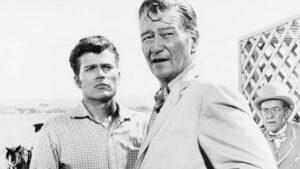
Actor Patrick Wayne, the second son of western star John Wayne, will make an appearance at Western Spirit Museum on Saturday, May 2 at 3 p.m. Wayne will have a one-on-one conversation with the Museum’s Chief Curator, Andrew Patrick Nelson, Ph.D., about his life and career in film. A question-and-answer session with the audience will follow.
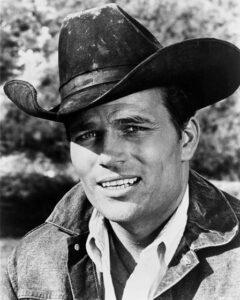 Patrick Wayne appeared in 11 films with his father, who was famous for his Western movies. Patrick made his movie debut at age 11 as an uncredited extra in Rio Grande (1950). After that, the two worked together on The Quiet Man (1952), The High and the Mighty (1954) (as a props assistant), The Conqueror (1956), The Searchers (1956), The Alamo (1960), The Comancheros (1961), Donovan’s Reef (1963), McLintock! (1963), The Green Berets (1968), and Big Jake (1971). Many of these movie posters are showcased at Western Spirit as part of the current exhibit.
Patrick went on to appear in numerous other films—including Shenandoah (1965), Sinbad and the Eye of the Tiger (1977), and Young Guns (1988), and hosted the TV game show revival Tic-Tac-Dough (1990-1991). He had TV roles in shows such as Charlie’s Angels (1976), Murder, She Wrote (1984), and Sledge Hammer! (1986). In 2003, he became chairman of the John Wayne Cancer Institute.
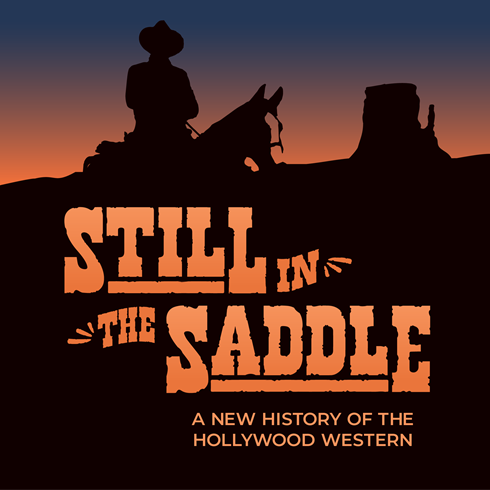
The special program is part of the Museum’s Still in the Saddle: A New History of the Hollywood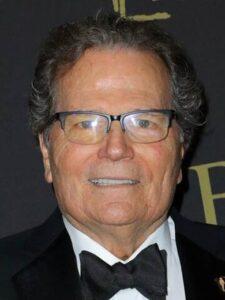 Western exhibition, which explores the dramatic and surprising evolution of the genre. Curated by Nelson, the nation’s leading authority on Western cinema, and drawn from the Museum’s collection—the world’s largest collection of Western movie posters—this expanded exhibition offers a definitive look at Hollywood’s greatest genre during one of its most turbulent and creative periods. The exhibition also features costumes worn on screen by Patrick’s father, John Wayne, adding a personal and compelling connection to the films that defined the Western.
The program includes a series of movie presentations (see below for more information). The movie screenings are FREE for Museum Members and FREE with Museum Admission. Or, it is $10 for program attendance only (does not include further admittance to the museum/galleries).
The movie schedule for the Still in the Saddle Film Series through June is as follows. Each showing is held at 2 p.m. Nelson, the Chief Curator will provide introductions and a post-discussion for many of the screenings.
April 12: Lawman (1971)
April 19: The Great Northfield Minnesota Raid (1972)
April 26: The Life and Times of Judge Roy Bean (1972)
May 3: Buck and the Preacher (1972)
May 10: Hannie Caulder (1971)
May 17: Little Big Man (1970)
May 24: A Man Called Horse (1970)
May 31: Ulzana’s Raid (1972)
June 7: Jeremiah Johnson (1972)
June 14: Chanto’s Land (1972)
June 21: The White Buffalo (1977)
The series continues through Dec. 27, 2026 with films under the themes The Duke, 1980s, 1990s, and Eastwood.
Still in the Saddle: A New History of the Hollywood Western
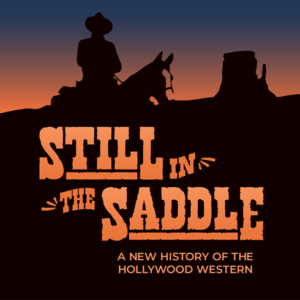 The exhibition unfolds across six thematic sections, each featuring original movie posters, film stills, and dedicated screens showing curated clip reels. Visitors will encounter over 70 original vintage posters alongside screen-worn costumes from John Wayne, Dustin Hoffman, Robert Redford, Charles Bronson, Jeff Bridges, and other icons of the era. The exhibition is bookended by two immersive cinema experiences. At one end, an evocative interpretation of Scottsdale’s historic Round-Up Drive In—complete with the iconic neon cowboy sign and large screen—transports viewers to an era when drive-ins dotted the Arizona landscape. At the other, a late-1960s movie theater lobby with period advertisements and concession menu (with prices that will make modern moviegoers nostalgic) gives way to a cinema screening highlights from the exhibition’s major films.
Reclaiming a Misunderstood Era
“The conventional wisdom is that the Western died in the late 1960s,” said Nelson. “But the truth is far more interesting. Against a backdrop of social unrest, political turmoil, and generational change, filmmakers were doing some of their most ambitious, provocative work. John Wayne was still the Western’s biggest star, but he faced stiff competition from Clint Eastwood, Robert Redford, and Paul Newman. Established directors like Howard Hawks worked alongside revolutionaries like Sam Peckinpah. The result was a period as rich and exciting as any in the genre’s history.”
Still in the Saddle is based on Nelson’s acclaimed book Still in the Saddle: The Hollywood Western, 1969-1980 (University of Oklahoma Press). The exhibition was organized by and premiered at the Briscoe Western Art Museum in San Antonio in 2021; this Scottsdale presentation has been significantly expanded, including a new section devoted to Clint Eastwood’s evolution from icon of change to the genre’s most thoughtful historian.
Exhibition Sections
The Western in 1969 — Sets the stage with an overview of a remarkable year: Butch Cassidy dominated the box office, The Wild Bunch ignited controversy, and John Wayne finally won his Oscar for True Grit.
Indians On Screen & Off — Addresses one of the genre’s most contentious aspects: its treatment of American Indians, and how filmmakers of the era began more concerted efforts to portray indigenous peoples with greater sensitivity and complexity.
Heroes in Changing Times — Examines how Westerns of the era challenged the myths of frontier heroes like Jesse James and Billy the Kid, reflecting a nation questioning its own legends during the Vietnam era.
The Duke — Focuses on John Wayne, whose later Westerns made the case that the hero’s values must be passed to the next generation if they are to survive.
The 1980s & Beyond — Traces the Western’s transformation from popular genre to prestige cinema, culminating in Dances with Wolves and Unforgiven both winning Best Picture.
The Man with No Name — A new section exploring how Clint Eastwood emerged after John Wayne as the genre’s next great interpreter, using the Western to explore questions of violence, justice, and national memory.
“By walking through this exhibition, visitors don’t just learn about these films—they experience how Americans encountered them,” said Nelson. “Whether at a drive-in under the stars or in a grand movie palace, these were shared cultural moments. We want people to feel that, and to come away with a new appreciation for just how vibrant and vital this period was.
Year-Long Programming
The exhibition will be accompanied by a full year of film screenings reflecting its sections and themes, along with talks by Dr. Nelson and visiting scholars and filmmakers. Screenings and programs take place in the Museum’s newly renovated Virginia G. Piper Theater. Visit westernspirit.org for the complete programming schedule.
Visitor Information
Still in the Saddle: A New History of the Hollywood Western is on view at Western Spirit Museum, located at 3830 N. Marshall Way, Scottsdale, AZ 85251.
Admission: $28 adults; $25 seniors and military; $12 students and children ages 6–17; free for children 5 and under. Memberships start at $75 for two adults.
For more information about Still in the Saddle, call (480) 686-9539 or visit westernspirit.org.
About the Curator
Andrew Patrick Nelson, Ph.D. is Chief Curator at Western Spirit: Scottsdale’s Museum of the West and a leading authority on Western cinema, art, and culture. He is the author and editor of numerous books and essays, including Still in the Saddle: The Hollywood Western, 1969–1980. Dr. Nelson’s insights have been featured in The New York Times, The Hollywood Reporter, and on NPR, and he regularly appears as a commentator on the History Channel and other networks. He also cohosts the popular Western movie podcast How the West Was ‘Cast.
Discover more from Arizona Progress Gazette
Subscribe to get the latest posts sent to your email.