

By Alexander Lomax
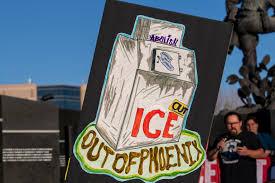
Photo Credit: Arizona Mirror
National issues are coming home to roost in our state: immigration enforcement is coming to Phoenix in force. According to recent reports, federal officials are planning to transform the metro area into what one former Department of Homeland Security official called “a hub of removal” in the Southwest. The planned expansion includes warehouse detention facilities in Glendale capable of holding thousands, alongside a significant surge of ICE agents already visible outside the agency’s downtown Phoenix headquarters.
The numbers tell part of the story. Arizona is home to an estimated 307,000 unauthorized immigrants as of 2023, with nearly 200,000 employed in the state’s workforce. The vast majority hail from Mexico. These individuals contribute an estimated $364.5 million in federal taxes and $228.5 million in state and local taxes annually, playing essential roles in industries from agriculture to construction.
But the Phoenix deployment appears to be about more than enforcement efficiency. Unlike previous ICE operations in Los Angeles, Chicago, Portland, and most notably Minneapolis, where clashes with local officials and protesters made headlines, Arizona presents a different political landscape. The state has Democratic leadership at the attorney general level but a more complex mixture of cooperation and resistance at the municipal level.

Photo Credit: Arizona Family’s Instagram
Democratic Attorney General Kris Mayes has taken an aggressive stance, warning that Arizona’s Stand Your Ground law creates unique dangers for ICE operations and vowing to prosecute agents who violate state laws. She’s encouraging residents to record encounters and send evidence to her office. Meanwhile, cities like Tucson have moved to block ICE use of city property, while other localities appear less resistant.
This seems to be precisely the confrontation the administration seeks. Where Chicago saw court orders against warrantless arrests and Portland declared a state of emergency, Arizona’s mixed responses and its Republican-leaning history on immigration make it an attractive target for demonstrating federal power. The detention infrastructure being built suggests permanence rather than a temporary surge.
The contrast with other deployments is notable. In Chicago, a federal judge ruled ICE illegally arrested 22 people and ordered their release. In Minneapolis, the fatal shooting of U.S. citizen Renee Nicole Good by an ICE agent sparked nationwide protests and prompted mass resignations at the Justice Department, and the most recent shooting death of Alex Pretti under a pretense of him being threat (although video evidence shows that while he was carrying a firearm in a holster, he never once brandished it and was forcibly disarmed before shots rang out) will undoubtedly continue the protests and contention. That said, these are operations in solidly Democratic strongholds.
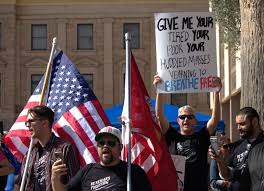
Photo Credit: Arizona Mirror
Arizona, with its border-state status, mixed political terrain, and substantial unauthorized immigrant population, offers different optics; a place where federal enforcement can proceed with less unified resistance while still generating the political theater the administration appears to value. Whether this proves pragmatic immigration policy or political posturing dressed as enforcement may depend less on deportation numbers than on which story the American public ultimately accepts.