

TAAAZE Takes Fight Against Axon Law to Arizona Court of Appeals
Opening Brief Maintains Controversial Law Is Unconstitutional Special Legislation
Appeal Seeks to Restore Scottsdale Voters’ Say on Massive Apartment Complex
(SCOTTSDALE, Ariz.) The fight for voters’ rights and against Arizona’s controversial “Axon Law” has moved to the Arizona Court of Appeals.
Taxpayers Against Awful Apartment Zoning Exemptions (TAAAZE) has filed its opening brief asking the Court of Appeals to reverse a Maricopa County Superior Court ruling and block enforcement of Senate Bill 1543. TAAAZE argues the legislation was specifically designed to benefit Axon Enterprise and prevented Scottsdale voters from having their say on the company’s massive apartment project.
The appeal was filed September 23 in Arizona Court of Appeals Division One. TAAAZE, Chairman Bob Littlefield and Scottsdale resident Tamara Goulden are the plaintiffs/appellants.
The appeal centers on a straightforward constitutional argument: Arizona’s Constitution prohibits special laws granting special or exclusive privileges when a general law can be made applicable.
TAAAZE argues the Axon Law violates that prohibition.
In the brief, TAAAZE’s attorneys say the legislation was “carefully and specifically tailored” to change zoning rules in the city where Axon wants to build and for the particular uses Axon wants. If that does not constitute unconstitutional special legislation, the brief says, “then it’s hard to imagine what is.”
SB 1543 requires certain Arizona cities with populations between 200,000 and 500,000 to allow multifamily housing and hotel uses on qualifying light-industrial property without requiring the type of application that would trigger a public hearing, shielding it from a citizen referendum.
While lawmakers said the purpose was to encourage corporate headquarters throughout Arizona, the law applies to just five municipalities. TAAAZE argues there is no reasonable connection between that limited reach and the stated statewide goal of attracting corporate headquarters.
“The Legislature said this was about attracting corporate headquarters to Arizona, but then wrote a law that excludes most of Arizona,” said Jean-Jacques Cabou, attorney for TAAAZE. “Our position is that this is precisely the kind of special legislation the Arizona Constitution prohibits. We are asking the Court of Appeals to enforce that constitutional protection and strike down the Axon Bill.”
The appeal is also about whether Scottsdale voters get a say in the proposed apartment development.
TAAAZE gathered more than 26,000 signatures after the Scottsdale City Council approved zoning changes allowing Axon to build 1,895 multifamily residential units, a hotel and commercial space. The Scottsdale City Clerk certified that enough signatures had been collected to place the issue before voters.
TAAAZE’s opposition is focused on the massive, unwanted apartment complex near Hayden and the 101 and whether Scottsdale voters get to decide its fate.
TAAAZE does not oppose Axon building its new corporate headquarters in Scottsdale. Axon already had and does have the zoning necessary to build the headquarters. TAAAZE opposes the residential component that followed — nearly 1,900 apartments, along with a hotel and additional commercial uses.
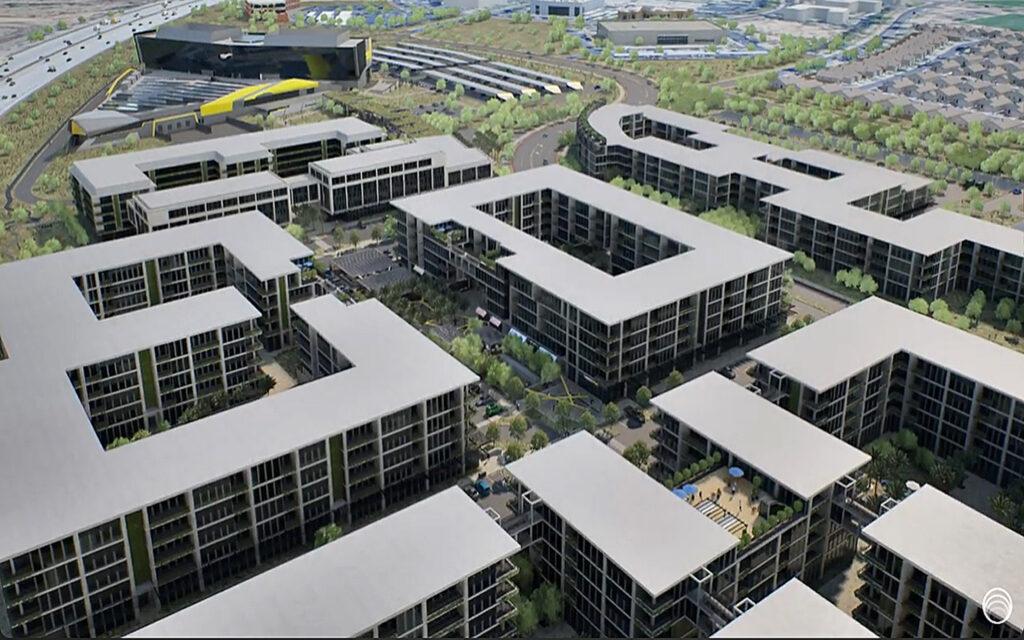
Axon Rendering
The Axon Law changed what happened next.
The appellate brief says SB 1543 “effectively (albeit indirectly) nullified the referendum” by requiring Scottsdale to allow qualifying multifamily residential development on Axon’s property. Scottsdale subsequently repealed the ordinance voters had referred to the ballot and entered into a Memorandum of Understanding with Axon.
“TAAAZE has never opposed Axon building its new headquarters in Scottsdale. Build it,” said TAAAZE Chairman and former Scottsdale City Councilman Bob Littlefield. “What we oppose is nearly 1,900 unwanted unnecessary apartments and a special law that takes the decision away from Scottsdale voters. More than 26,000 people signed petitions to have their say. They deserve to have it. The Axon Law amounts to voter nullification.”
In a carefully worded ruling, the Superior Court declined to block the law, concluding in part that the statute could apply in cities other than Scottsdale.
TAAAZE’s appeal argues that the constitutional question is not how many cities technically could fall under the law, but whether its limited reach has a rational connection to the statewide purpose lawmakers used to justify it.
Discover more from Arizona Progress Gazette
Subscribe to get the latest posts sent to your email.