

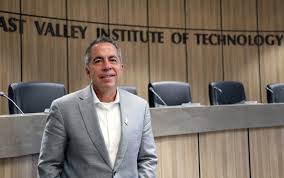
Photo Credit: Arizona Capitol Times
Dr. Wilson, thank you so much for your time. As the cost of traditional four-year colleges and cumulative student loan debt continues to balloon, non-traditional educational routes are becoming more and more salient, and none locally have the reputation and track record of the East Valley Institute of Technology (EVIT).
You’ve led EVIT for over 7 years through significant changes in workforce development and education policy. What’s the most important lesson you’ve learned about balancing accountability with innovation in career technical education?
In CTE, and in education more broadly, innovation and accountability must go hand in hand. We cannot improve outcomes without innovation, and innovation only matters if it leads to measurable results. While it’s important to explore new programs and ideas, our work must ultimately be accountable to the students and families we serve and to the taxpayers who fund it. EVIT was the first Career Technical Education District created in Arizona over 30 years ago because East Valley taxpayers chose to invest additional resources to improve the quality and cost-efficiency of CTE for high school students. That responsibility requires us to continually evaluate what is working, what is not, and how effectively we are using public funds. We owe that diligence to our students and to our taxpayers.
EVIT now serves Phoenix-area adults in addition to East Valley high school students. What gaps in the adult workforce training landscape were you trying to fill, and how do the needs of adult learners differ from high school students in your programs?
One of the most significant gaps in adult workforce training has been the pathway to becoming a registered nurse—a profession in critical need across Arizona. While community colleges offer nursing degrees, long waiting lists often delay students from entering nursing coursework until well after completing general education requirements. To address this, EVIT pursued legislation in 2022 allowing CTEDs to offer associate degrees in high-demand fields. EVIT’s nursing associate degree program has no waiting list and enables students to develop nursing skills while completing their general education courses. In just five semesters, graduates are prepared to sit for the licensing exam to become registered nurses. Arizona also faces a substantial need for skilled workers in the industrial trades, including electrical, plumbing, HVACR, and welding, as well as licensed professionals in fields such as cosmetology and aesthetics. These programs are especially attractive to adult learners—whether they are changing careers or advancing within their current field. EVIT meets their needs by offering focused, hands-on training without unnecessary time or expense, at costs competitive with community colleges and significantly lower than private providers.
You offer more than 50 career training programs. How do you decide which programs to launch, expand, or sunset? What labor market data informs those decisions, and how quickly can you adapt to changing workforce demands?
At EVIT, we spend significant time listening to business and industry partners to understand workforce shortages and the specific skills they need. Preparing students for real jobs is the core purpose of CTED funding. That responsibility goes back to the promises made to taxpayers who agreed to pay more for this education. Their investment is not intended for elective or exploratory courses; it is meant to support training that leads directly to employment in the field of study. Because of that responsibility, EVIT tracks outcomes at both our central and satellite campuses. Programs that are not producing results are placed on improvement plans, and the EVIT Governing Board may ultimately decide to discontinue them. Business and industry are not our only market—students and parents matter as well. Programs with consistently low enrollment are evaluated for possible sunsetting, as it is not a responsible use of public funds to continue offering programs students do not choose. Conversely, when enrollment and outcomes are strong, we expand. Our electrical program is a clear example. Electrical is a high-demand career field in Arizona. What began as a program for high school students has quickly expanded to include adult learners and a paid apprenticeship. This growth has occurred within just the past few years and demonstrates EVIT’s ability to respond quickly to workforce needs. The same is true for our associate degrees in nursing and surgical technology. Legislation enabling CTEDs to offer associate degrees passed in 2022, and by 2024 both programs were fully operational.
There’s an ongoing national debate about the value of traditional four-year college degrees versus career technical education. Two-thirds of EVIT’s students continue to college after completing your programs. How do you see CTE fitting into students’ broader educational journeys?
EVIT has always been a strong fit not only for students who choose not to pursue college, but also for those who do. Many students in our nursing assistant program, for example, go on to earn college degrees in nursing. By starting at EVIT, they are able to determine early whether patient care is the right fit for them and gain the ability to work as CNAs while completing their college education. The same is true for students planning to pursue college degrees in fields such as construction. Students who begin at EVIT in construction, plumbing, HVACR, or welding enter college with a solid, hands-on understanding of their chosen field rather than learning it for the first time in a classroom. Most importantly, CTE allows students to experience what a job is actually like while they are still in high school. At a time when too many students are leaving college without a degree—and with significant debt—CTE helps students make more informed decisions and pursue clearer, more intentional career pathways.
You’ve mentioned that EVIT’s central campus maintains a 95% program completion rate, while satellite programs have lower persistence rates. What accounts for that gap, and what role should districts play in improving those outcomes?
Some programs at EVIT’s central campuses have completion rates as high as 95%, but overall, the central campus rate is closer to 79% (78.7%). We are working daily to improve that, because it should be higher. In contrast, our CTED satellite programs in district high schools have much lower outcomes, with a 27.1% persistence rate and a 21.5% completion rate. This is unacceptable and reflects the fact that some districts treat these programs like general electives rather than true workforce training. CTED funding from taxpayers is intended to prepare students for careers—not to support courses simply used to fill schedules or explore interests. We are committed to helping our satellite programs succeed and are ready to collaborate with districts to bring programs up to expected standards, but that requires districts’ willingness to work with us.
You’ve emphasized that satellite programs should be workforce preparation, not general electives. How do you distinguish between the two in practice, and what happens when a district’s CTE program doesn’t meet EVIT’s standards for workforce readiness?
True workforce-preparation CTE programs are those where students persist, complete their training, earn industry-recognized credentials, and either enter the workforce in that field or continue their education in it. These measurable outcomes are what our elected EVIT Governing Board evaluates each year when deciding whether to continue a satellite program. Before reaching that point, however, EVIT works closely with CTE directors in our member school districts to support program improvement—we want every program to succeed.
The Fire Science Academy partnership with Scottsdale Unified and the Scottsdale Fire Department has been highlighted as a model for collaboration. What made that partnership work when others have struggled, and what do you see as the key ingredients for successful district partnerships?
The Fire Science Academy was created through EVIT’s IGA (intergovernmental agreement) negotiations with Scottsdale. By state law, we are required to have IGAs with our districts that define our mutual responsibilities. EVIT currently partners with 11 school districts in the CTED program, as well as American Leadership Academy, to offer EVIT satellite programs. When our IGA expired last summer, we decided to negotiate individually with each district to create agreements tailored to their unique needs. For example, the needs of Scottsdale differ significantly from those of J.O. Combs in the San Tan Valley. While we proposed individual meetings, only Scottsdale, Mesa Public Schools, and American Leadership Academy agreed to meet. As a result, we now have updated IGAs with these three partners, while the remaining nine districts have chosen to pursue legal action instead. I am deeply grateful to Scottsdale, Mesa, and American Leadership Academy for prioritizing their students’ needs. Their collaboration made the Fire Science Academy in Scottsdale possible, bringing a valuable resource to that community. It also enabled the new EVIT CNA program at our Red Mountain campus, opening in July in Mesa, which will provide students another pathway to earn CNA certification and first consideration for EVIT’s associate degree program.
You mentioned that there’s a big difference between “traditional wood shop and professional carpenter training.” For parents and students trying to understand what makes quality CTE, what should they look for in a program?
There’s an important distinction students and parents should understand: taking a traditional woodshop class can teach basic skills, but it does not prepare you to be a professional carpenter or work in construction.
If your goal is a career in this industry, you should look for a CTE program that:
- Focuses on hands-on, career-specific training
- Prepares students to earn industry-recognized certifications and licenses
It’s also important to ask about the teacher’s qualifications:
- Have they worked in the industry?
- How recently?
- Do they understand what it takes to get hired and succeed today?
Finally, review the program’s placement data:
- What percentage of students are placed in jobs or continue their education in the same field?
- How many students actually go into careers or college programs related to the program?
This information gives a clear picture of how well the program prepares students for real-world careers.
If you could wave a magic wand and change one thing about how Arizona structures, funds, or governs career technical education districts, what would it be and why?
We strongly urge that Arizona’s CTED law be clarified and strengthened to ensure it is unmistakably clear: control over the quality of CTED programs, both at the central campus and at all satellite sites, and control over CTED funding must reside solely with the elected CTED Governing Board. The nine districts currently suing EVIT seek to bypass accountability and dictate how CTED dollars are spent. Allowing this would jeopardize the quality and consistency of career and technical education programs across Arizona, deny students equitable access to high-quality opportunities, and put taxpayers’ investments at risk. Arizona’s students deserve career and technical education programs that meet rigorous standards, regardless of where they learn. Strengthening the law to affirm the Governing Board’s sole authority ensures that every student, in every district, benefits from programs designed to prepare them for success in the workforce, while safeguarding the public’s investment in these essential educational opportunities.